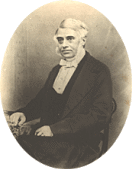
 JOSEPH CHARLES PHILPOT (1802-1869)
Preached at Eden Street Chapel, Hampstead Road, London, on Lord’s Day Evening, July 24, 1853.
"And this word. Yet once more, signifieth the removing of those things that are shaken, as of things that are made, that those things which cannot be shaken may remain. Wherefore, we receiving a kingdom which cannot be moved, let us have grace, whereby we may serve God acceptably with reverence and godly fear." -Heb 12:27,28
WHEN God gave the law upon Mount Sinai it was with fearful accompaniments. Inanimate nature herself gave tokens of recognition of her Almighty Creator, and trembled at His fearful presence. "And it came to pass on the third day in the morning, that there were thunders and lightnings, and a thick cloud upon the mount, and the voice of the trumpet exceeding loud; so that all the people that was in the camp trembled. And Mount Sinai was altogether on a smoke, because the Lord descended upon it in fire: and the smoke thereof ascended as the smoke of a furnace, and the whole mount quaked greatly."
To these visible tremblings of the earth before her awful Creator the Psalmist alludes, Ps 68:8, "The earth shook, the heavens also dropped at the presence of God: even Sinai itself was moved at the presence of God, the God of Israel." So also Ps 77:18, "The voice of Thy thunder was in the heaven: the lightnings lightened the world: the earth trembled and shook." To this fearful display of God’s terrible majesty at Mount Sinai the Apostle Paul refers in the chapter before us: "Ye are not come unto the mount that might be touched, and that burned with fire, nor unto blackness, and darkness, and tempest, and the sound of a trumpet, and the voice of words" Heb 12:18,19.
Now these accompaniments, when Mount Sinai was wrapped in smoke and flame, and the solid earth shook, were to denote God’s majesty, holiness, and justice, in the giving of the law. But there was something more intimated in the shaking of the earth. It was typical and figurative of the shaking of the foundations on which men rested. When the stable earth itself was shaken, all hopes built upon that earth were shaken with it. It also denoted the shaking of that earthly idolatrous worship which was prevalent, in order to make way for the Levitical dispensation which was to last until the coming of the promised Messiah. We gather this from the remarkable prophecy of Haggai, to which the apostle refers in our text, and explains. As this forms the groundwork of our subject, and is the key to our text, we will devote a few moments to it.
In Hag 2:6,7, we find the following prediction: "For thus saith the Lord of hosts: Yet once, and it is a little while, and I will shake the heavens, and the earth, and the sea, and the dry land; and I will shake all nations, and the desire of all nations shall come: and I will fill this house with glory, saith the Lord of hosts." In these striking words Haggai refers to the giving of the law on Mount Sinai, when the voice of God shook the earth. "But now," says the apostle, quoting and explaining Haggai’s words, "He hath promised saying, Yet once more I shake not the earth only, but also heaven." When was this prophecy fulfilled’? Clearly at the coming of Christ, for when God shook the heavens, "the desire of all nations should come," and the temple then building was to be filled with glory, which it was when the glorious Son of God, in human form, entered into its courts. But how were the heavens and earth then shaken’? Were they not literally so at Christ’s crucifixion, when the sun withdrew his light, when the earth quaked, and the rocks were rent? These visible commotions in heaven and earth were, to a certain extent, fulfillments of the prophecy. But the apostle takes a wider scope, and explains the prediction spiritually, as referring to the shaking and consequent removing of the Levitical dispensation. This interpretation of the apostle will form the groundwork of our subject, in which there are five distinguishing features.
I. The removing of those things which may be shaken.
II. The remaining of those things which cannot be shaken.
III. The receiving of a kingdom which cannot be moved.
IV. The holding it fast by the power of divine grace.
V. The fruits and effects that spring out of receiving and holding an immovable kingdom.
I must ask your attention this evening. The links in this chain are so very closely connected, that unless you give me your attention you will perhaps be hardly able to see the beauty and blessedness of the subject brought by the apostle before us.

